Human-Led · AI-Enhanced
AI-Enhanced Impact Management
Spend less time searching, compiling and writing, and more time acting on your evidence. TolaData’s AI works on your own documents and programme data, within the permissions your team already has. Currently being rolled out with a small number of users.
What It Means for Your Team
Three optional features that take the busywork out of monitoring, evaluation and reporting. Each can be switched on independently.
Knowledge DatabaseFind answers in seconds
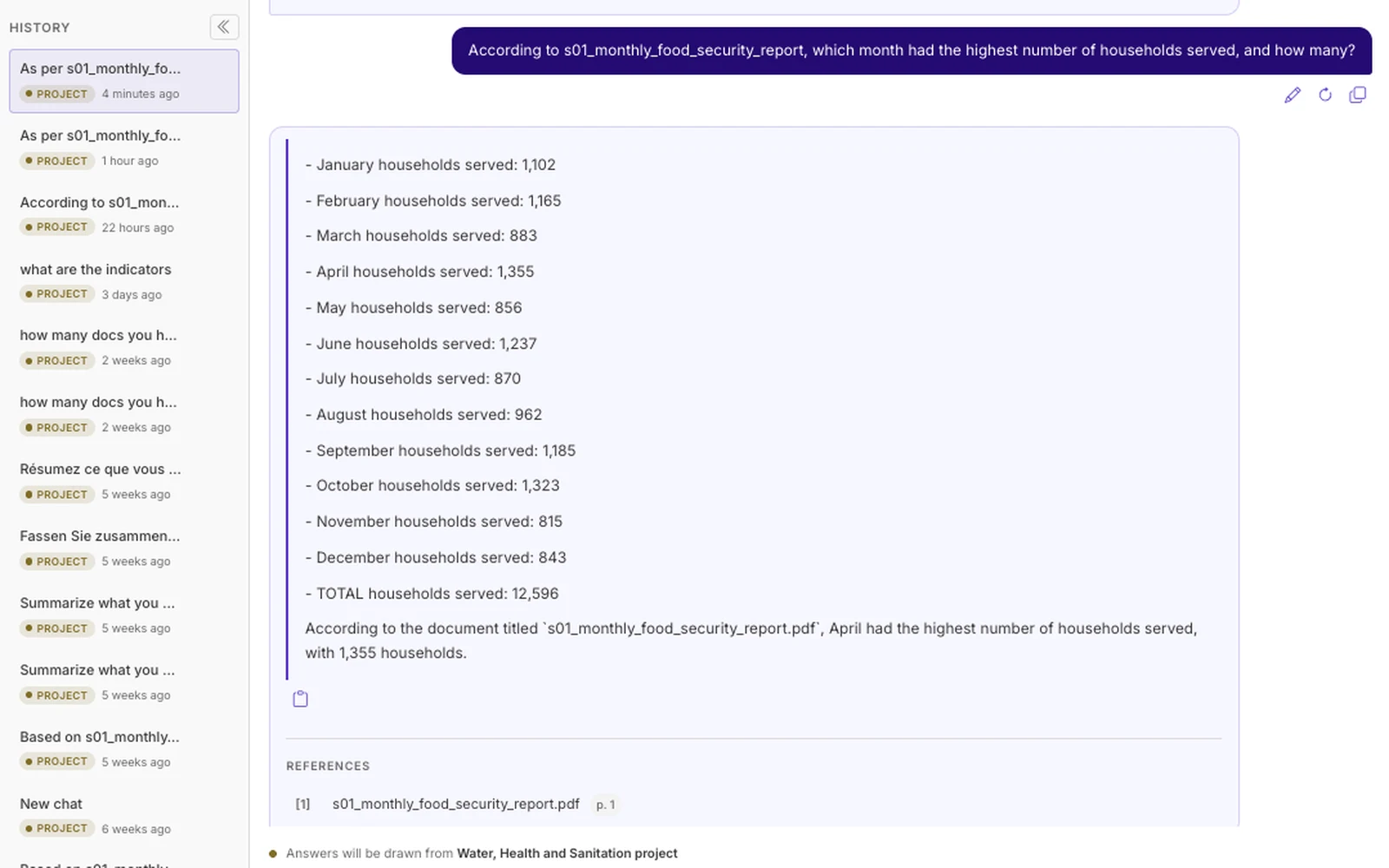
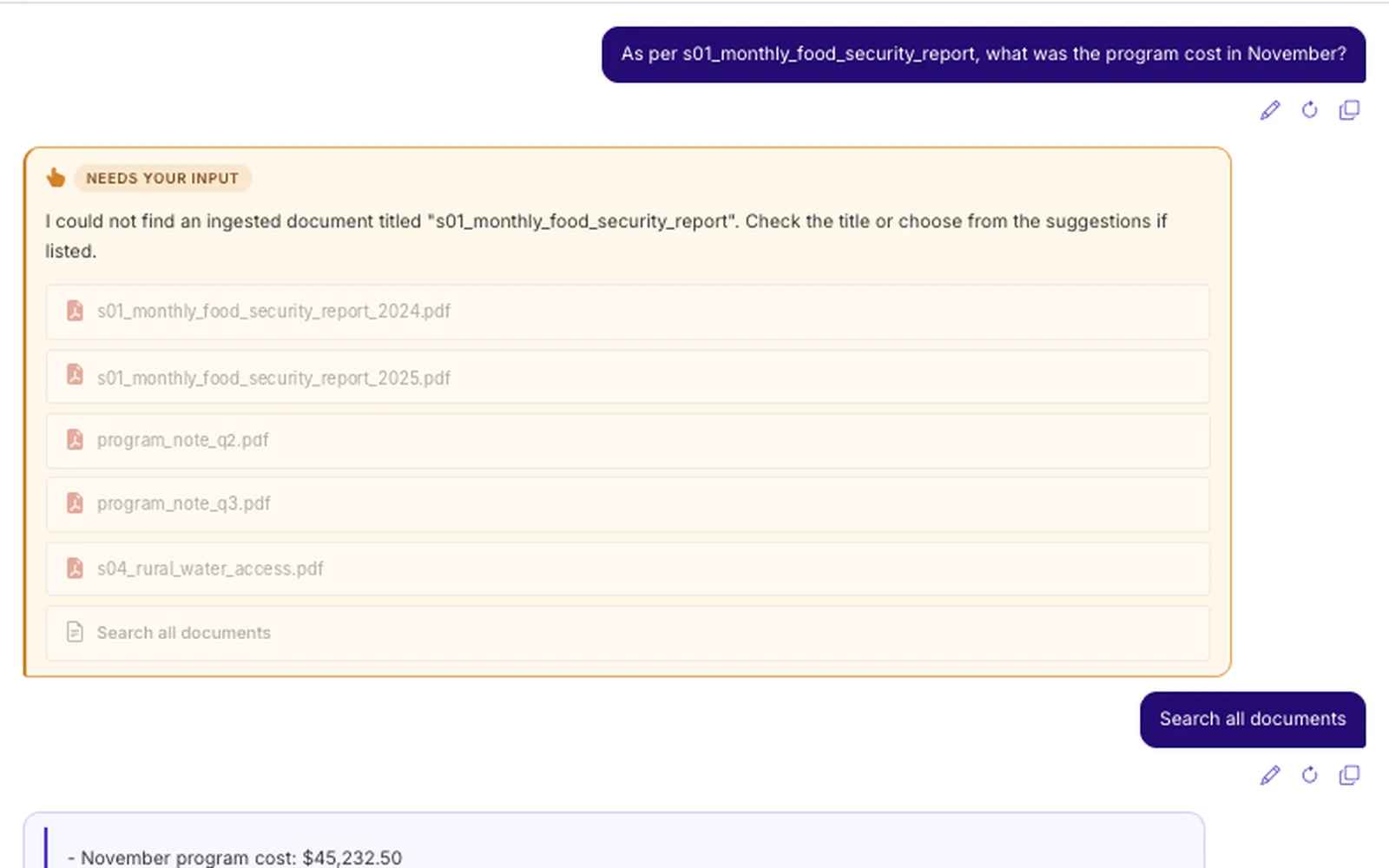
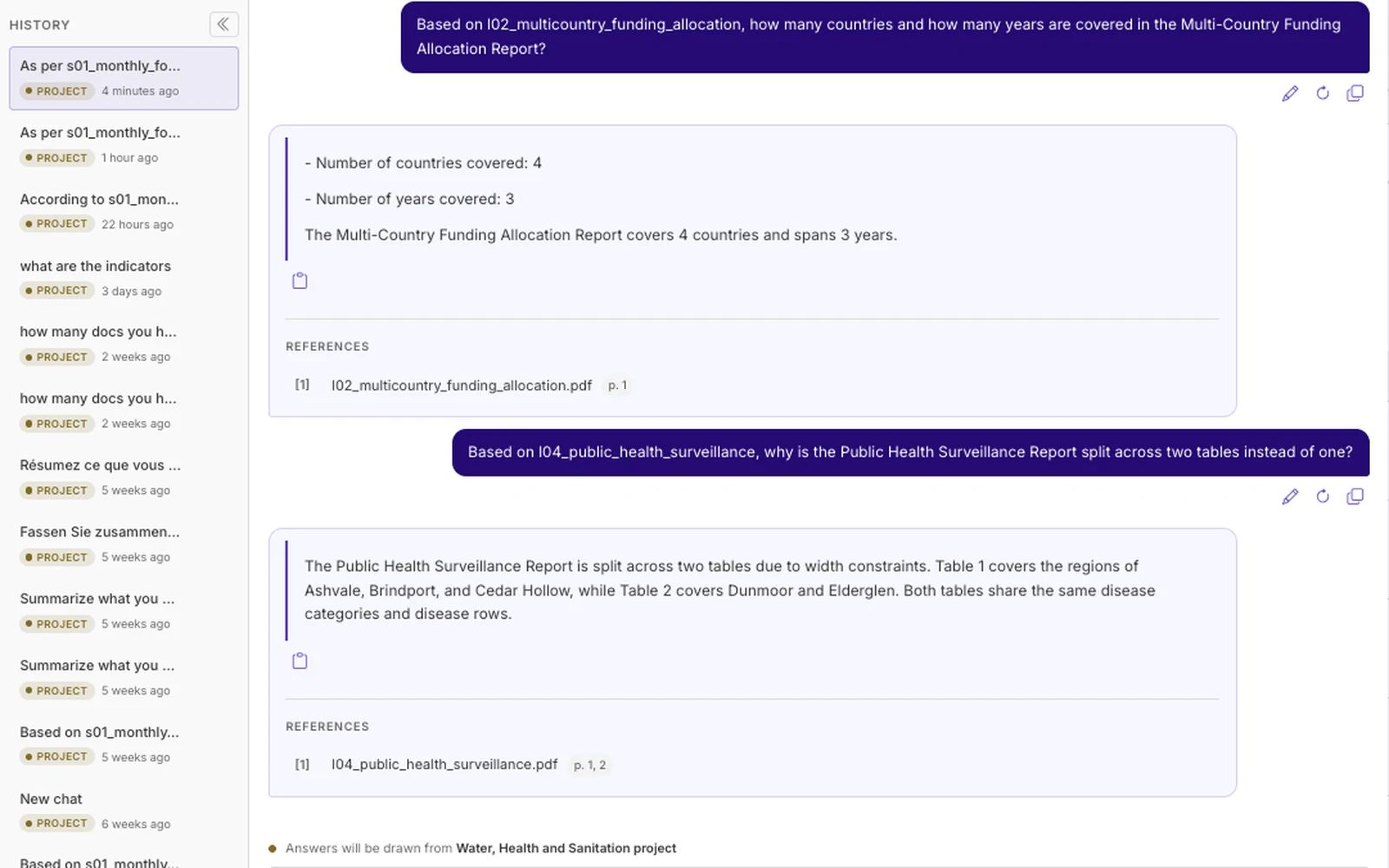
- Ask your reports, proposals and evaluations in plain language instead of digging through folders
- Trust what you read: every answer names the document it came from
- Keep institutional knowledge usable when staff move on
Data Analytics AssistantKnow where your programme stands
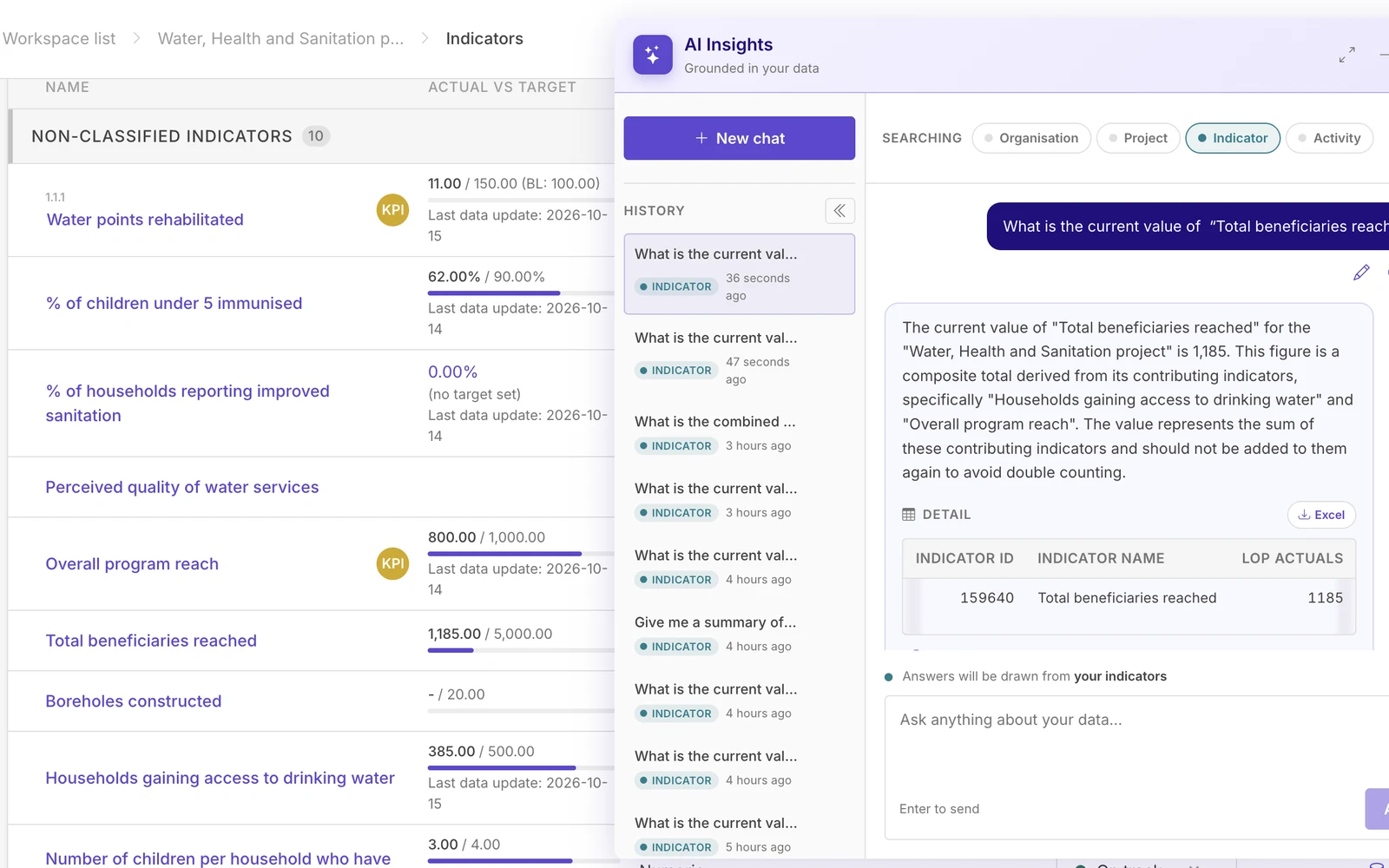
- Get answers about progress without waiting for an analyst or building a query
- Spot indicators that are off track well before reporting deadlines
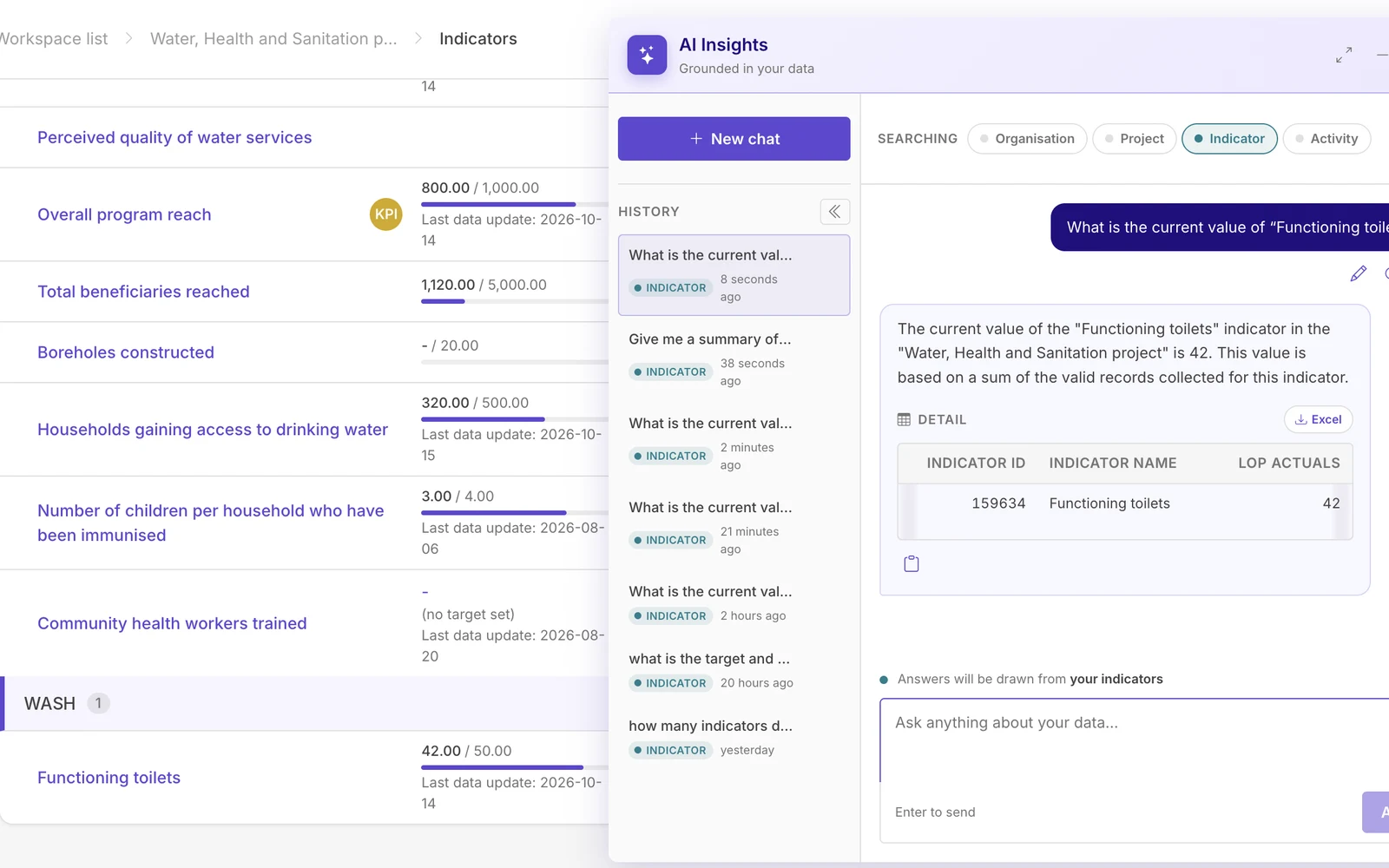
- See the figures behind every answer, ready to export to Excel
Report GenerationStart reports from a draft, not a blank page
- Turn your indicator data and documents into a structured first draft
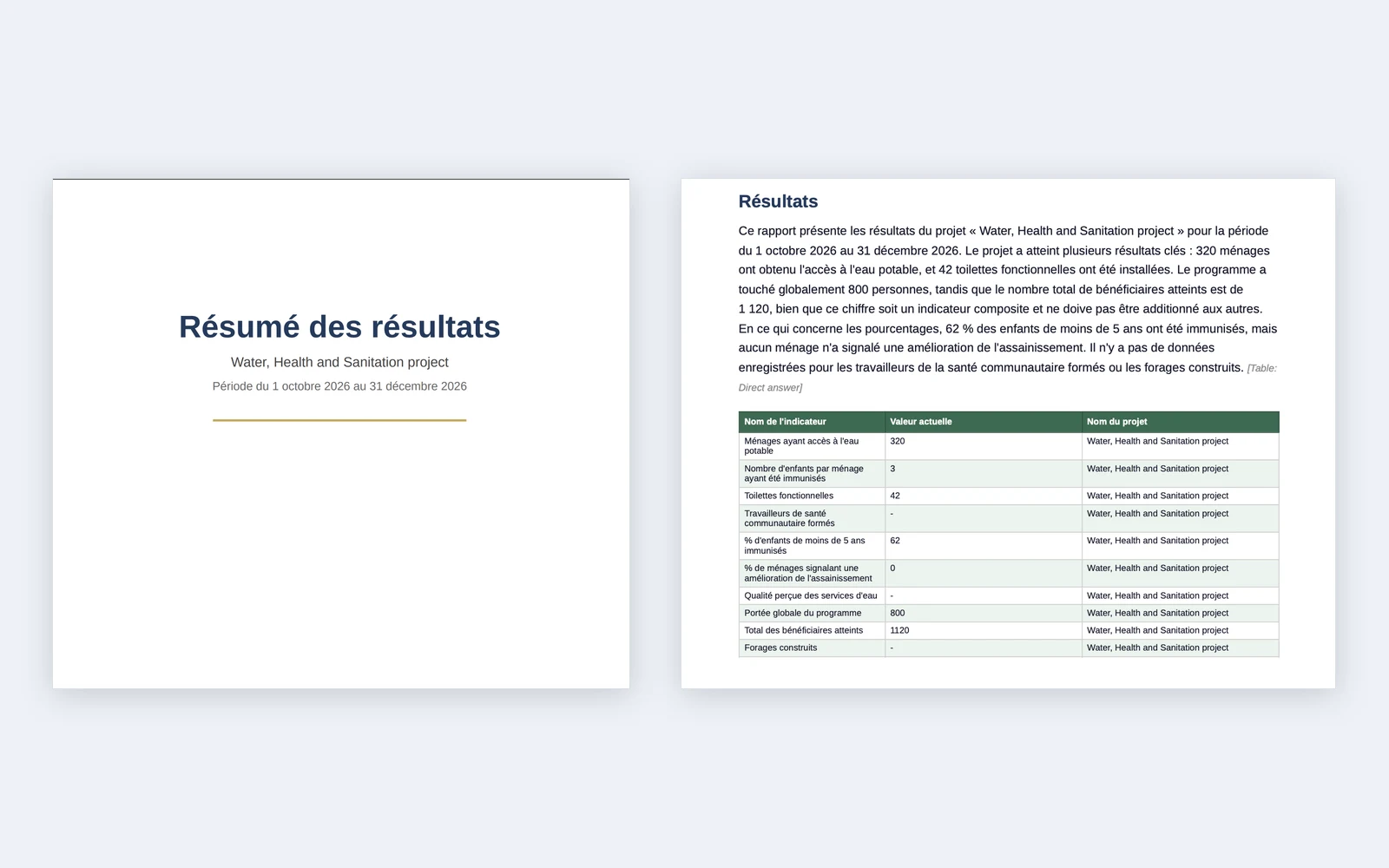
- Draft in the language your donors and partners need
- Every figure comes from your own data, and your team signs off before anything is shared
In Action
Knowledge Database
Ask questions of your project documents and get answers that name their sources.
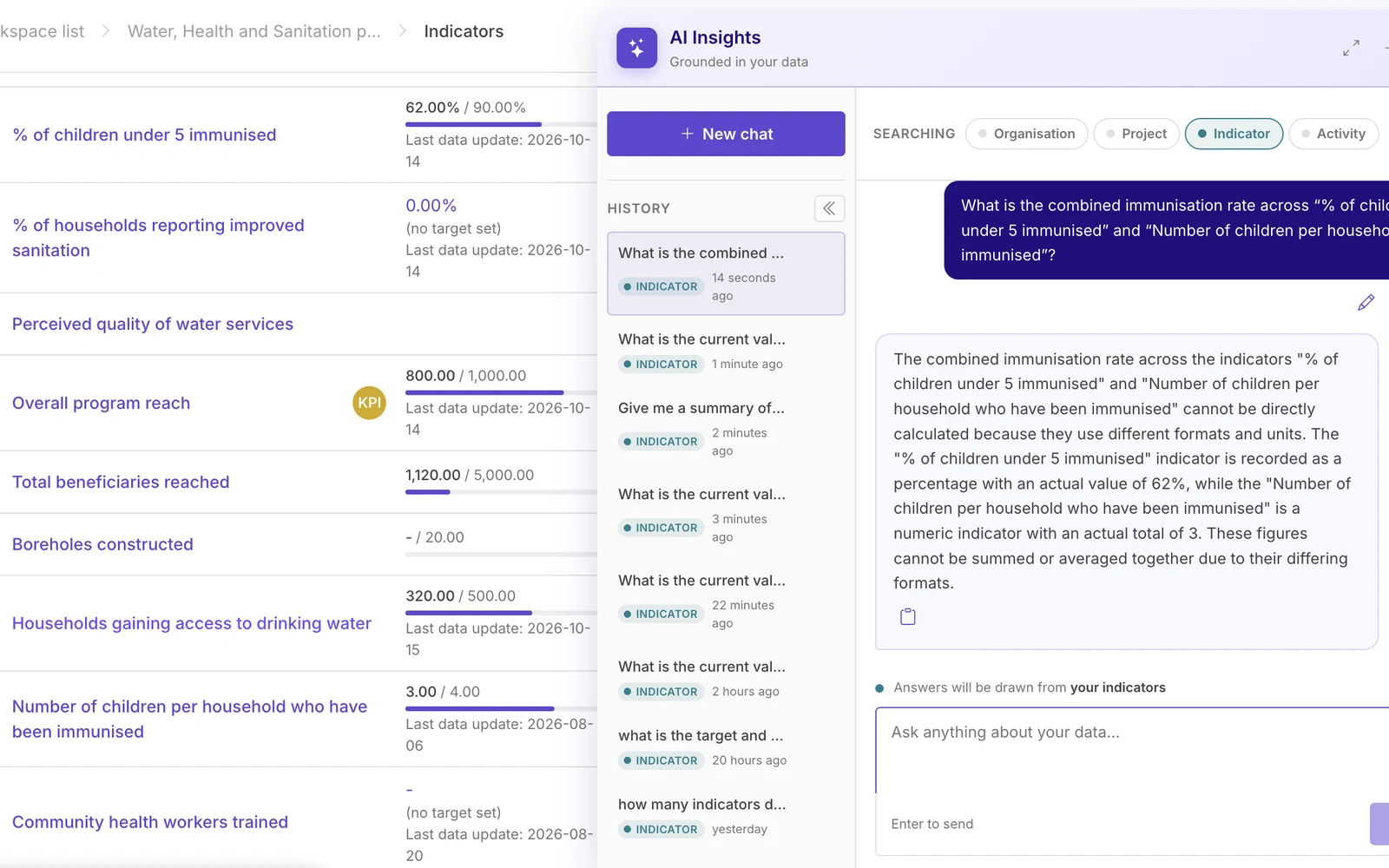
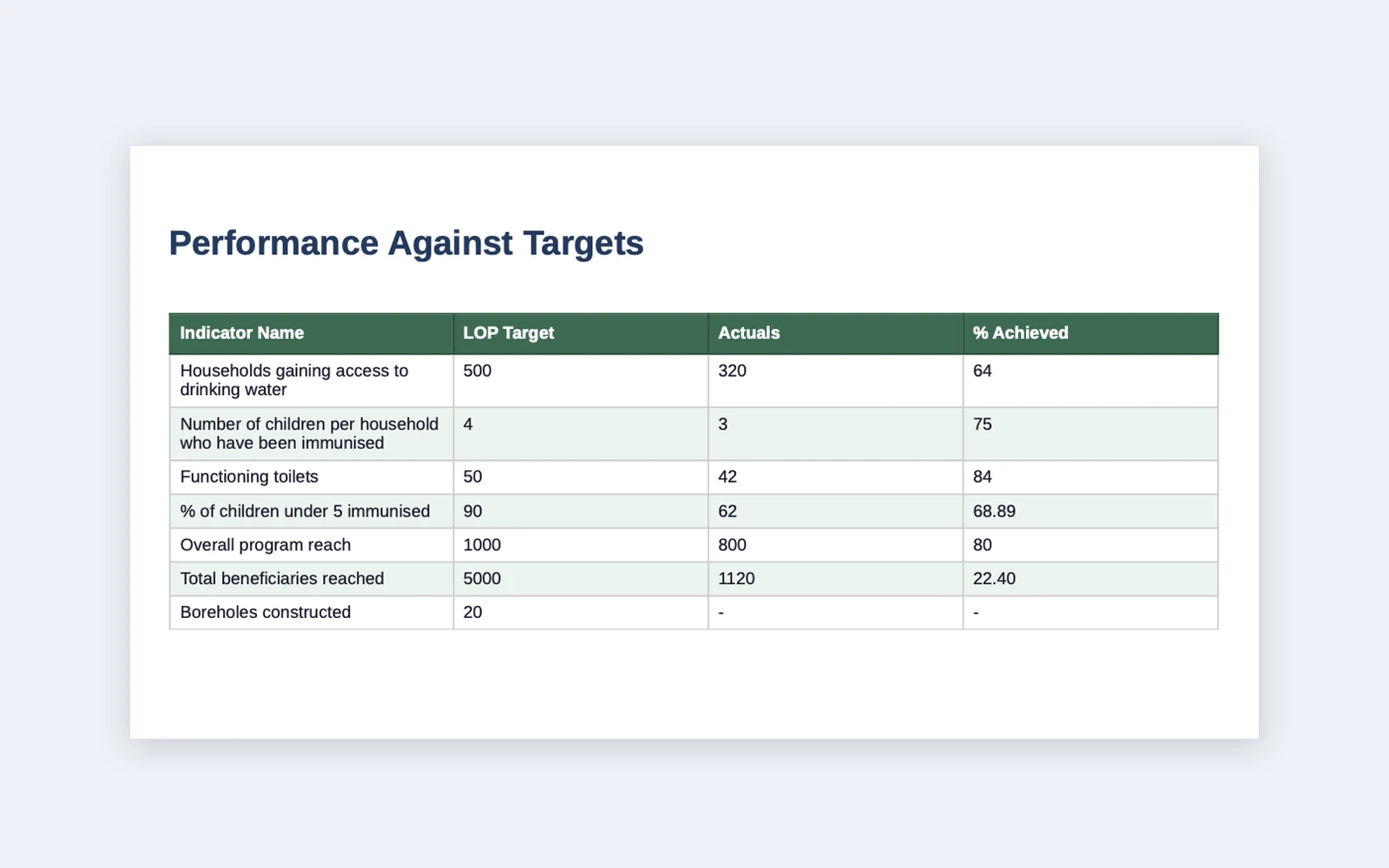
Data Analytics Assistant
Ask questions of your live indicator data, with the figures behind every answer.
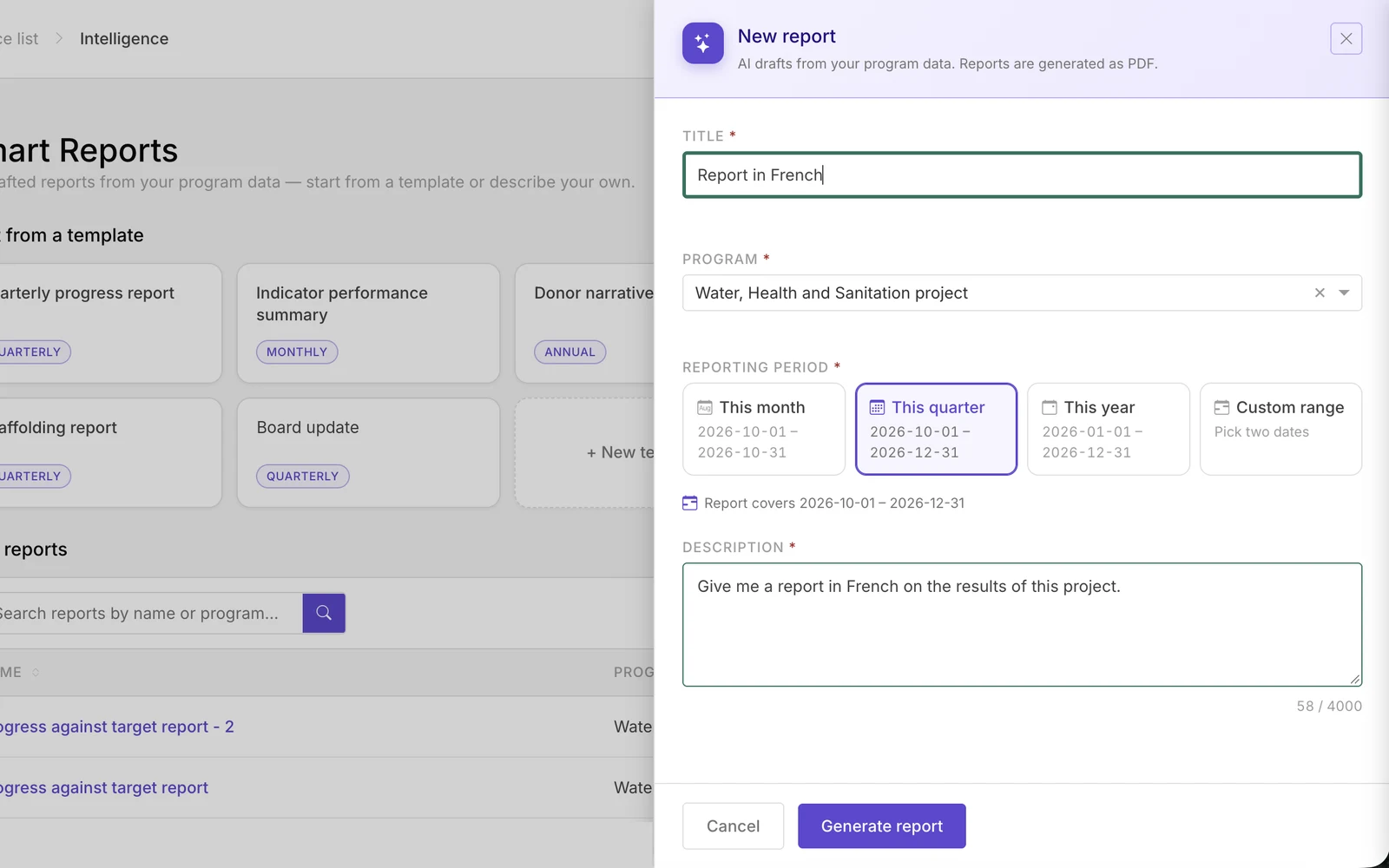
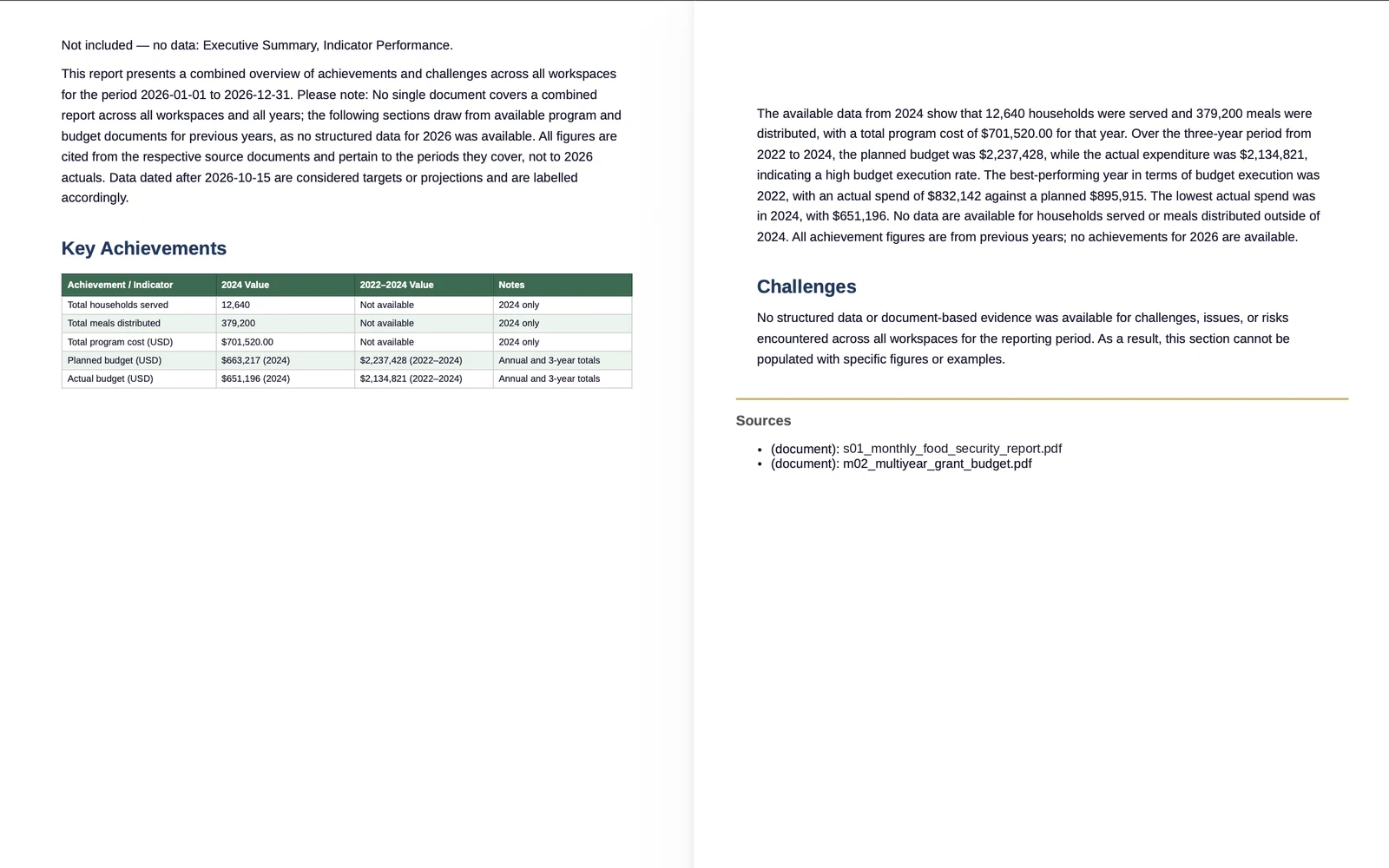
Report Generation
Describe the report you need and get a PDF draft built from your programme data.
Built on Trust
Your Data Stays Yours
Your data is never used to train AI models. The AI sees only what your account can already access, cannot change your records, and is covered by our Privacy Policy and Data Processing Agreement.
Your Team Stays in Control
Every answer, analysis and report is a draft for human review, with sources cited. Each feature is off by default and switched on only at your request.
Built for Impact Work
AI layered on proven MEL workflows, not bolted on, from a team with a track record alongside GIZ, Fairtrade International and dozens of development, research and social impact organisations.
Grounded in Your Evidence
Figures are checked against your data, gaps are flagged rather than filled in, and when a question is unclear the AI asks instead of guessing.
FAQs
When will the AI features be available?
The AI features are currently being rolled out with a small number of users, with wider availability planned for late 2026 and 2027. If you’re interested, get in touch.
Will our data be used to train AI models?
No. TolaData uses the OpenAI API under business terms, where submitted data is excluded from model training by default. Your questions, data and the responses are not used to train any model — ours, OpenAI’s or anyone else’s — and are not shared with other customers.
Will our data be used for anything else?
No. TolaData does not use your questions, uploaded content or AI-generated output for internal testing or product development beyond providing the AI features to you. We do use feedback you choose to give, such as ratings or comments on an answer, to improve the features.
What data does the AI actually see?
Only what a request needs: for a document question, up to four of your documents; for a data question, your database structure and a sample of query results with internal identifiers removed. Report generation draws on more of your data than a single question. The AI never receives data from other organisations, from projects your account can’t access, or passwords and credentials.
Are the features switched on automatically?
No. Every AI feature is off by default. Each one is enabled separately, only when your organisation requests it in writing, and can be switched off again at any time. The rest of TolaData works exactly as it does today either way. When the Knowledge Database is switched on, documents already stored in TolaData are indexed straight away, and a short opening extract of each is sent to OpenAI to generate a summary. The other features send nothing until a user makes a request.
Can other organisations or users see our data?
No. Your organisation is identified from your signed login and enforced on every document search and database query. Within your organisation, users can only query data they can already see in TolaData — the AI inherits your existing permissions.
Can hidden instructions in a document manipulate the AI?
We use a layered approach to stop instructions hidden in uploaded documents from influencing the AI:
- Instructions and content kept separate: documents are treated as untrusted reference material, and the AI is explicitly told to disregard instructions embedded in them.
- Organisation-level isolation: the AI can only retrieve and process documents belonging to your organisation.
- Role-based access control: the AI respects existing permissions, so users only see information they are authorised to view.
- Restricted AI capabilities: access to databases, APIs and other system resources is restricted, with authorisation enforced in the backend independently of the AI model.
- Input and output validation: requests and responses are checked for prompt-injection attempts, unauthorised data disclosure and security violations.
- Sensitive data protection: safeguards prevent the exposure of credentials, API keys and data outside the user’s permissions.
- Prompt-injection testing: security testing covers malicious instructions, hidden prompts and attempts to bypass controls.
- Monitoring and logging: suspicious activity and potential prompt-injection attempts are logged and monitored.
Where is our data processed, and how long is it kept?
Your documents, search indexes and application data are hosted and processed in the EU, and document search runs on TolaData’s own infrastructure. Answer generation, and a short summary of each document when it is indexed, use the OpenAI API under its global processing configuration, so this data may be processed outside the EU, including in the United States, under Standard Contractual Clauses. OpenAI may retain inputs for up to 30 days solely for abuse monitoring. We are working with OpenAI to enable EU Data Residency and Zero Data Retention, but cannot yet commit to a timeline. Your conversation history is stored in your TolaData environment and can be deleted on request.
Which AI model do you use?
The AI features run on OpenAI’s GPT-5.4. We will inform clients of significant changes, including a change of model or model version.
Is it GDPR compliant?
Yes. TolaData acts as your processor under Art. 28 GDPR, and the AI features are covered by our Privacy Policy and Data Processing Agreement, available on our Terms & Policies page. We also provide a DPIA support pack on request.
How accurate are the outputs?
Generally high quality, but not infallible. Answers cite their sources, figures are checked automatically against the data supplied, and gaps are reported rather than filled in. AI can still misread a question or miss nuance, so every output is a draft — review it before use, especially for donor reporting.
Can the AI change or delete our data?
No. The analytics assistant is restricted to read-only queries, and any statement that would insert, update or delete data is rejected before it runs. Nothing the AI produces is written back to your records.
How much will it cost?
Pricing is being developed in consultation with our clients and in line with industry standards. The AI features will be an optional add-on to your TolaData subscription.